It’s one in the afternoon. There is a gentle knock on the door.
I say, “Please come in.” It is Dr Jouhar.
The doctor checks how many times I have been to the toilet. Then asks me to lie down and goes on to check my pulse, nadi and stomach with quiet efficiency.
“Lunch will be served in the room soon. Coconut water at four. Try and take a walk around five-thirty.”
The consultation lasts barely five minutes. He never wastes a word, but he never appears rushed either. Somehow, in those few minutes, he notices everything. I might have passed today’s test, but I do not know my grade yet.
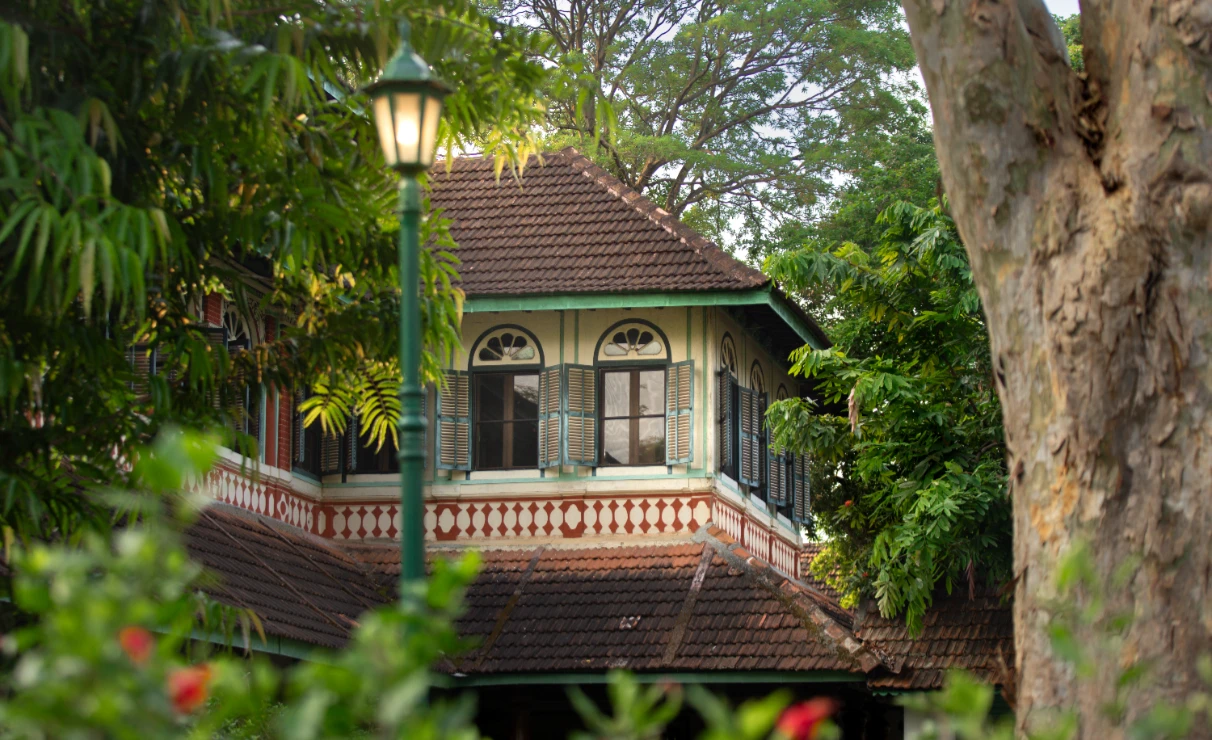
I have now been at Kalari Kovilakom, a sanctuary for traditional Ayurveda in rural Kerala, for a week. In the local Malayalam language, the name loosely translates to “the royal training ground” – Kalari comes from the ancient martial art form of Kerala. The building itself was once home to nobility before being lovingly restored as a place of healing.
I have stayed in many beautiful properties over the years, but Kalari occupies a category entirely on its own. It combines uncompromising traditional Ayurveda with gracious, almost invisible hospitality. Restfulness here has little to do with indulgence. It comes from discipline, attention and care – the optimal training ground for self-care.
The estate itself is well-spread without ever feeling grand. Its lush grounds are shaded by mature trees and healing plants. Butterflies drift lazily between flowering shrubs. Three ponds feed the cormorants with plenty of fish.
Then there are the permanent residents. The squirrels and the mongoose family.
Before I understood the rhythm of Ayurveda, I found myself watching them. The squirrels seemed permanently occupied, darting from branch to branch with astonishing efficiency. The mongoose family moved differently – less hurried, always together, teaching their young one to forage before disappearing quietly into the undergrowth.
At the time, I thought little of them. I did not know they would stay with me long after.
Soon after arrival, we were ushered to our rooms and handed a set of white pajamas. This would be our uniform for the rest of our stay. Freshly laundered sets arrived magically at five pm every day.
Quietude is expected in public spaces, more so at meal times in the dining hall.
Everyone dresses alike. The first impression is simplicity, almost austerity. Yet behind all this lies remarkable generosity. Everyone – including the squirrels – seems to act like custodians in an ancient palace of healing.
The dining hall quickly becomes my favorite place to observe people.
There are first-timers looking a bit tentative, wondering what exactly they signed up for. Then there are veterans who greet staff like old friends. Some have returned six-seven times. Some have just arrived and others are about to finish. My guess is over three-quarters of guests (or patients) are repeat visitors.
Depending on the stage of treatment you happen to be in, Kalari can feel like an extraordinary wellness retreat where you feel focused and grounded – the anti-Instagram – or a remarkably civilized minimum-security prison. My crime – ignoring my health.
People ask me what brings me here. Some people suffer from seasonal allergies. I seem to get them round the year. For years, I have dealt with persistent rhinitis. More recently, I have also been feeling low on energy, mildly anxious, the occasional racing heart and aversion to cardiovascular exercises. All the symptoms of sub-clinical stress.
My ambitions were modest. If I could breathe and sleep better, I would be happy. A pink tongue will be an added bonus.
My mornings begin with a walk and a consultation with the doctor. Dr Jouhar checks my sleep, blood pressure, bowel, pulse and my tongue. He then prescribes my treatments and diet for the next day. He does not look one day older than he did in 2019.
For the first few days, every morning, I was required to drink increasingly heroic amounts of medicated ghee. By the third day, I was feeling distinctly lethargic. There had been a few visits to the bathroom and I found myself privately hoping my course would end soon. Mercifully, I was spared after day four.
During this period, breakfast disappeared. Lunch consisted of little more than gruel.
As a schoolboy, I occasionally emerged from a test declaring, “that was gruelling.” In eighteenth-century English slang, “to get one’s gruel” meant to receive severe punishment. At school, I had no idea where it came from. After four days of ghee and gruel, now I understood what it feels like.
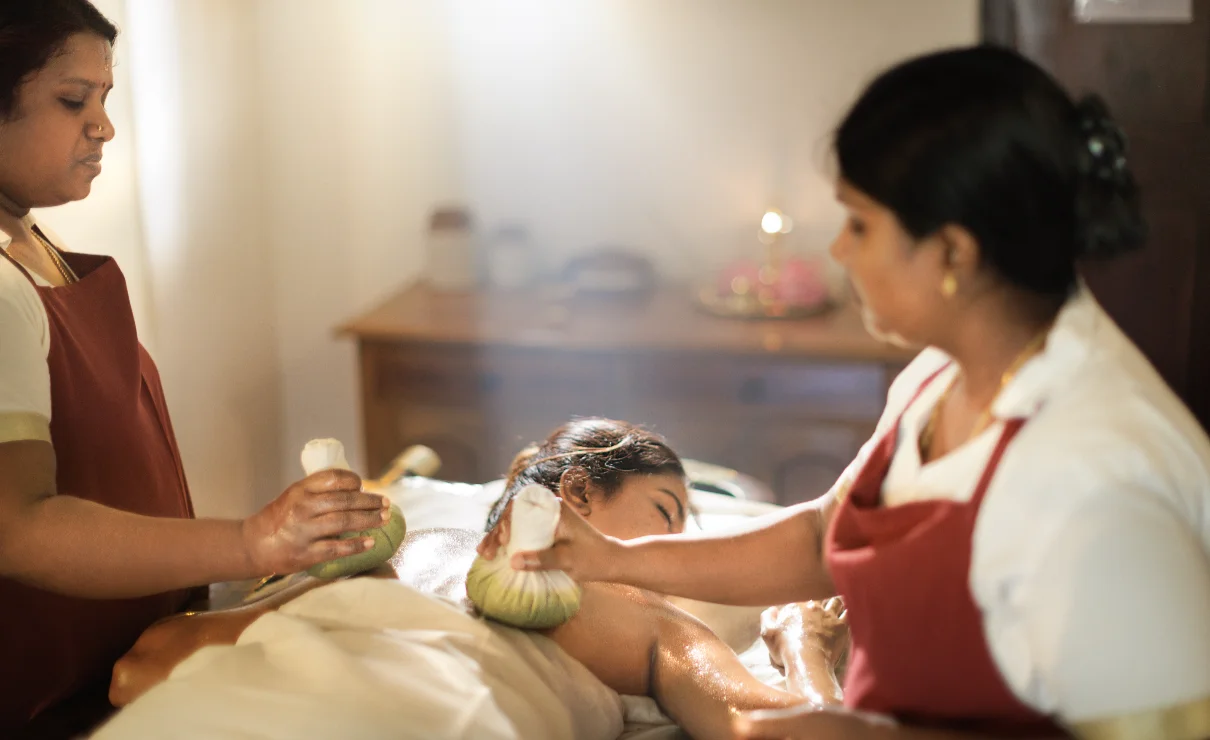
Phase one of the treatment reaches its climax with virecha – therapeutic purgation – when one waits quietly in the room for nature to complete its work.
At four pm, I get to drink two glasses of delicious coconut water. At six thirty, I hear the dinner bells. I get kitchdi for dinner. I will get steamed apple for breakfast tomorrow.
When I arrived, my attention had been directed towards symptoms, sleep scores and heart rates. As the week progressed, almost without noticing, my attention had begun drifting elsewhere.
Towards the rain, towards trees, the squirrels and the curious little mongoose family.
The second week settled into a quieter rhythm.
I began walking at dawn. The estate rewards early risers. Overnight rain had become a familiar visitor, leaving the gardens washed every morning. The air carried the fragrance of wet earth, neem and mango leaves while butterflies drifted briskly between flowers.
The squirrels had already begun their day’s work, as did the mongoose family.
Most mornings, I would find them near the gardens, patiently teaching their youngest where to search for earthworms or the occasional unfortunate frog. Watching them became part of my own morning ritual. There was something reassuring about lives that carried on entirely unaffected by schedules, blood pressure readings or digestive milestones.
One morning, I set out early because I knew what awaited me later.
It was the day of Kashayavasti, known rather less elegantly as the “big enema.” I would be lying if I said I approached it with serenity. The smaller doses over the past two days had been mere trailers.
The purpose, as Doctor Jouhar assured, was to cleanse toxins from my lower digestive tract while improving metabolic and nervous systems. I preferred to think of it as getting a brand-new gut. By now, I trusted the process completely.
Much of that confidence came from Vishnu, my lead therapist, and his colleagues. No words can capture the therapeutic skill of Vishnu and his team. Vishnu had looked after me on my previous visit in 2019.
Watching him work, I was often reminded of the squirrels outside. Focused, efficient and never distracted. Every movement had a purpose.
When Dr Jouhar was briefly away attending to other patients, his duties were divided between the two senior doctors, Dr Jeyan and Dr Manoj. All the doctors are much beloved by their respective patients for their care, empathy and professionalism.
The same quiet professionalism extended throughout Kalari. From Latha at the front office to housekeeping, or Shaji, the head chef, and his crew, everything functioned with a grace that many luxury hotels aspire to but rarely achieve.
As my mind slowed down, my senses were more awakened.
Many mornings, I wandered towards the lotus pond. For several days, one particular bud caught my attention. It stood willowy above the water, seemingly unchanged despite nights of heavy rain. Then, overnight, it opened into a magnificent lotus. It was transcendental.
That night, another storm arrived. The following morning, I walked back to the pond expecting to get a second viewing of the lotus. Most of its petals had fallen, sadly.
Sitting quietly at breakfast, waiting for my bowl of pear, I found myself thinking about the lotus. For days, the bud had withstood rain without damage. Yet, once it opened to its fullest beauty, a single night of storm was enough to scatter its petals.
I wondered if it was quietly reminding me of something about our own lives.
When we are young, like the lotus bud, we are protected by tightly knit family and community. As adults, sometimes we stand alone, more independent but also more exposed to the elements. It was a gentle reminder that our strength comes in togetherness and belonging.
One evening, the estate gathered for an Ottamthullal performance – a traditional dance-drama created centuries ago to bring wit and satire to ordinary folks. It shares the expressive storytelling of Kathakali with humour.
The performance was in Malayalam, so I understood none of it. Yet I laughed that evening more than I had in months. Perhaps laughter, like music, needs little translation. We had all arrived carrying different burdens – stress, aching joints, restless sleep or the quiet accumulation of modern life. Healing, I realized, sometimes arrives disguised as laughter.
Before I knew it, my final few days had arrived. I was sleeping much better. My resting heart rate had dropped nearly ten beats. Even my tongue seemed pink-ish.
Feeling pleased, I asked Dr Jouhar, “How is my tongue now?” With a smile, he replied, “From where we started… pink enough.”
On the final day, late afternoon, I retreated to the verandah outside my room with a book. Somewhere between the final chapters, I drifted into sleep and caught a dream.
I found myself in Rishikesh. A dear friend was walking beside me along the banks of the Ganges, where the river gathers itself and takes a sharp turn before leaving the mountains and beginning its journey towards Haridwar and the plains beyond. It is one of my favorite places to be in India.
That day, our conversation was about the afterlife, not surprising given the setting.
I turned to him and said, “Imagine we’ve both reached heaven. The Divine offers us two choices. We can return as humans again, but we cannot choose who we become. Or we may return as animals we wish.”
He smiled and said, “Hard choice. I think I’d come back as a squirrel.”
“Why?” I asked.
He answered, “They move through their turf with purpose. They are agile, industrious, self-reliant and light-footed. Your turn now.”
I thought for a moment and said, “I think I’d come back as a mongoose.”
“Why?” he asked.
“Family always comes first. They stay together. They protect one another. They don’t look for trouble, but if trouble comes looking for them, they know exactly what to do.”
Then the bell rang. It was half past six, time for the last meal.
As I walked slowly towards the dining hall, I instinctively glanced at the trees. The mongoose family had disappeared into the undergrowth. The squirrels were announcing it was time to sleep.
As I waited for my final dinner, I realized healing rarely arrives all at once. More often, it comes quietly through discipline, attention, laughter, nature, music and the patient accumulation of ordinary days.
Sometimes all we need is good company.
Raj Mishra
Kalari Kovilakom,
Palakkad, Kerala,
July 2026
Palakkad, Kerala,
July 2026
Disclaimer
The sole purpose of this article is to provide information about Ayurveda. This information is not intended for use in the diagnosis, treatment, cure or prevention of any disease. If you have an acute or chronic health concern, please consult an Ayurveda doctor who can fully assess your needs and address them effectively.